Ratio and Regression Estimators
COMPARISON BETWEEN RATIO AND REGRESSION ESTIMATORS
ATMADIP CHAKRABORTY
2148103
INTRODUCTION:
Information on an auxiliary variate which is highly correlated with the variable under study is readily available in many surveys. This can be used for improving sampling design. In case data on auxiliary variate for individual sampling units are not available, the aggregate data on auxiliary variate can still be used at the time of estimation of the parameters under study, provided the data on auxiliary variate for the sampled units can be easily obtained while recording the values of the study variate. Ratio method of estimation and regression method of estimation are two such methods of estimation. We are going to discuss in brief about these two estimators and also find out which one of them has the better efficiency.
RATIO ESTIMATOR:
Frequently we come across situations in which the ratio of y to another character x is believed to be less variable than the y's themselves. In that case it would be better to estimate R, the ratio of y to x. In the population, from the sample and then multiply it by the known total of x to estimate the total for y. This procedure is called ratio estimation.
Frequently we wish to estimate a ratio rather than a total or mean, for example, it is desired to estimate a ratio rather than a total or mean, for example, it is desired to estimate the total agricultural area in a region containing N communes. There are very big communes and very small communes and this makes the character y very tremendously over the region. but the ratio of agriculture area and the population size of the commune, which is the per capita agricultural area, would be less variable.
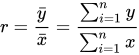
Let Y and X be the total agricultural area and the total population in the region respectively. Then the per capita agricultural area in the region is R=Y/X. If a small random sample of n communes gives ∑yi and ∑xi where i = 1 to n, as the total for y and x, respectively. The following estimates can be done through ratio estimation:

The sample ratio (r) is estimated from the sample:



REGRESSION ESTIMATOR:


Comparison between ratio and regression estimators:
Aim:
The
main aim is to derive the estimate of the population mean using regression
estimation and compare it with ratio estimation
Objective:
To
estimate the average real estate farm loans assuming that the average non-real
estate farm loans in the country is known and is equal to $878.16. Also using
the regression estimator to give the estimates with 95% confidence interval for
this data set and discuss the results.
Notations:
X - Non-real estate farm loans
Y - Real estate farm loans
Data Description:
Given below is a random sample of 21 states from a population of 50
states of a country using SRSWOR


We first get our scatter plot to see the correlation and find the
value of the correlation coefficient.


The value of correlation
coefficient is moderately high
Now we use the auillary varaible X and use regressor model function
which gives the regression coefficient “b”. Using the weights from X we estimate
the values of Y.


Now we will calculate the variance using regression estimator
Standard Error = First finding the unbiased estimate of the vraiance
of ybar and then finding the square root of it. For this we need correlation
coefficient (r),N,n and sample mean square y (sy2)

Ratio Estimate

Conclusion:
1. Standard error of regression
estimator is less than standard error of ratio estimator, hence regression
estimator is a better method of estimation than ratio.
2. The data shows a moderately
high correlation between the variables. We obtain the regression estimate as
0.39819 with a standard error of 0.03368 The estimate of the mean is $594.1101
with the standard error estimate of 68.15831. The 95% confidence interval is
(736.2859,451.9344). With the given value of the estimator of the mean, we can
conclude that the population mean lies within these values.
3. On comparing with ratio
estimator whose standard error is 121.1869, we can conclude that regression
estimator (with standard error 68.15831) is a better estimator than ratio
estimator


Comments
Post a Comment